
Scenario planning and stress tests expose hidden liability gaps that standard insurance overlooks. Asset Protection, Inc. recommends modeling worst-case financial shocks, such as a catastrophic lawsuit or business collapse, to evaluate how legal structures like LLCs perform under pressure. This proactive analysis identifies vulnerabilities before a real crisis strikes, ensuring wealth remains secure.
Key Takeaways
Legal stress tests apply one severe shock at a time to identify precise failure points in asset structures.
Scenario planning explores multiple possible future outcomes under various conditions to support strategic planning.
A properly constructed stress test reveals whether charging order protection functions as intended under creditor pressure.
Without this discipline, clients discover weaknesses only after a lawsuit begins, which arrives too late.
What is a legal stress test?
A legal stress test evaluates how well an entity withstands extreme adverse conditions by applying severe shocks to specific risk factors. The method isolates vulnerabilities before a crisis exposes them. High-net-worth individuals and business founders use this discipline to measure whether current structures survive aggressive creditor action.
The approach differs from broader scenario planning, which explores multiple possible future outcomes under various conditions to support strategic planning. A stress test narrows the focus. It applies one severe shock at a time. The goal is a precise failure point, not a range of possibilities.
How does a legal stress test differ from scenario analysis?
The distinction matters for asset protection design. Stress testing applies severe shocks to specific risk factors. Scenario analysis explores multiple possible futures under various economic conditions. One measures resilience. The other maps uncertainty.
What does a legal stress test reveal?
A properly constructed test exposes gaps in liability shielding. It shows whether a Family Limited Partnership holds under creditor pressure. It reveals whether charging order protection functions as intended. The wealthiest American and European families have always structured holdings to keep wealth intact across generations. A stress test verifies that structure still works.
The process follows a clear sequence:
Identify the specific legal threat, such as a judgment creditor or regulatory action.
Apply a severe but plausible shock to the entity’s liability exposure.
Document which assets remain protected and which become reachable.
Adjust the structure to close any identified gaps.
Without this discipline, clients discover weaknesses only after a lawsuit begins. That discovery arrives too late.

Why run scenario planning for lawsuits?
Scenario planning for lawsuits exposes hidden liability gaps before a creditor strikes. A legal stress test reveals exactly where wealth structures fracture under real litigation pressure. Without this discipline, high-net-worth families carry exposure they never see until a judgment arrives.
The technique has a long history at major corporations. Yet McKinsey‘s 2013 survey of business leaders found that 40 percent said scenario planning did not meet expectations. The failure stems from a predictable human error. Leaders routinely “chop the tails off the distribution” and focus only on scenarios resembling current experience. A physician or real estate investor does the same thing. They imagine a lawsuit that looks like yesterday’s dispute. They miss the catastrophic outlier that destroys unprotected assets.
What makes litigation scenarios different from standard risk assessment?
Standard risk assessment measures probable losses. Litigation scenarios model improbable but devastating legal attacks. A standard review asks whether insurance covers a slip-and-fall claim. A litigation scenario asks what happens when a business partner files a fraudulent conveyance action after a judgment. The difference is the severity of the shock and the speed of the cascade.
How do families plan for lawsuits using structured analysis?
Families who plan for lawsuits effectively follow a disciplined sequence. First, they identify every entity and asset title. Second, they stress-test each structure against specific legal threats. Third, they document the rationale for every transfer and formation decision. The Family Limited Partnership serves as the cornerstone of almost every asset protection plan. When properly structured, it creates a formidable barrier that forces creditors into charging order remedies rather than direct seizure. Asset Protection, Inc. builds these asset protection plans around precisely this architecture.
How to run scenario planning risk-02 demands rejecting comfort. The exercise works only when participants model conditions far outside their experience. A real estate investor must simulate a tenant lawsuit combined with a simultaneous market collapse. A medical professional must model a malpractice claim that exceeds policy limits while personal guaranties on practice loans come due. These compound shocks reveal whether existing structures hold or collapse. The analysis produces specific remediation steps: retitling assets, adding entities, or restructuring ownership chains. Each step closes a gap that standard planning overlooks entirely.
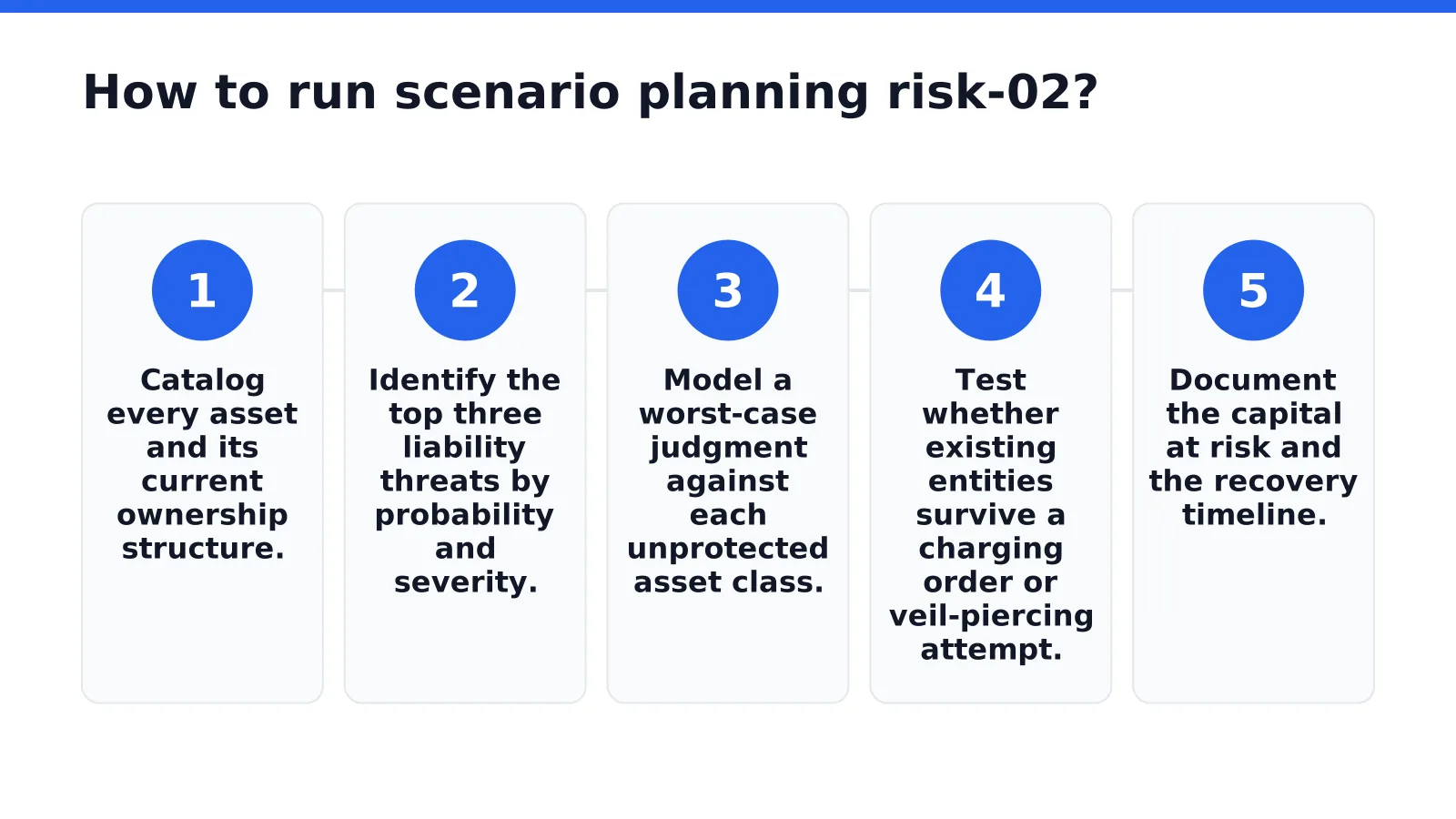
How to run scenario planning risk-02?
A legal stress test evaluates how a high-net-worth individual’s holdings withstand aggressive creditor attacks. The process maps specific litigation threats against existing protective structures to expose gaps before a lawsuit materializes. Without this analysis, families lose assets that proper planning would have shielded.
What is the first step in a legal stress test?
The first step identifies the most probable litigation scenarios facing the client. A medical professional faces malpractice exposure. A real estate investor confronts tenant and premises liability claims. Each profile demands a different threat model. The analysis then applies severe shocks to key risk factors, mirroring how financial stress testing evaluates capital adequacy under extreme conditions.
How do you structure the scenario planning exercise?
Scenario planning for legal threats follows a numbered sequence:
Catalog every asset and its current ownership structure.
Identify the top three liability threats by probability and severity.
Model a worst-case judgment against each unprotected asset class.
Test whether existing entities survive a charging order or veil-piercing attempt.
Document the capital at risk and the recovery timeline.
An LLC offers limited liability and charging order protection, which limits what creditors can seize. This structure keeps personal assets safe when a business faces trouble. Corporations carry deep roots in U.S. law, with a Supreme Court ruling in 1886 granting corporate personhood and many of the same legal protections individuals hold. The exercise reveals whether these tools perform under duress.
What makes a litigation scenario realistic?
Realistic scenarios incorporate actual court procedures and creditor behavior. A plan for lawsuits must assume aggressive opposing counsel who will challenge entity formalities and pursue alter-ego claims. The test applies severe shocks to key risk factors such as personal guarantee triggers or inadequate insurance limits. Asset Protection structures each engagement around this adversarial modeling. Clients who integrate umbrella insurance and liability strategies close the gap between entity protection and catastrophic loss. The final output is a prioritized remediation roadmap, not a theoretical report.
What litigation scenarios should you test?
Litigation scenarios test how a specific legal threat would affect personal and business assets. A structured review identifies which holdings face the greatest exposure before a lawsuit arrives.
That discipline starts with testing realistic threats. A legal stress test applies a hypothetical claim against each asset class. The goal is to find gaps before a creditor does.
Which structures hold up under a lawsuit?
Business entities offer protection that personal ownership does not. Businesses can use legal structures like LLCs and corporations to shield wealth in ways individuals cannot. Testing these structures reveals whether they actually perform under pressure.
Follow these steps to run a litigation scenario review:
List every asset by ownership type: personal, trust, LLC, corporation, or partnership.
Apply a hypothetical judgment to each asset class.
Identify which assets a creditor could reach directly.
Compare the exposure of personal holdings against entity-held assets.
Document the gaps that require restructuring.
How does a family limited partnership respond to legal threats?
The FLP has been used by tax lawyers for many years as a vehicle for recurring family income and estate taxes. A plan for lawsuits should test whether the FLP structure holds when a creditor targets a limited partner’s interest. Charging order rules often limit what a creditor can seize. Testing that limitation before litigation confirms the structure works as intended.
Scenario planning for legal risk is not a one-time exercise. High-net-worth clients should revisit these tests whenever assets move or business structures change.
How to plan for lawsuits effectively?
Effective lawsuit planning begins with a structured scenario planning process that identifies vulnerabilities before they become crises. Asset Protection, Inc. builds these strategies on the highest standards and ethical practices, ensuring every protective measure meets rigorous quality benchmarks. Without a proactive framework, high-net-worth individuals and business founders risk losing assets that took decades to accumulate.
A legal stress test examines how existing structures hold up under extreme litigation scenarios. This method applies severe shocks to specific risk factors, revealing weaknesses that standard reviews miss. The company’s administrative teams dedicate themselves to trouble-free and efficient operations, so clients receive fast, friendly service throughout the evaluation.
What is the first step in creating a litigation defense plan?
The first step involves cataloging every asset and its current legal exposure. Asset Protection, Inc. then maps potential creditor attack vectors against each holding. This inventory creates the foundation for all subsequent protective moves.
How does a legal stress test differ from standard risk review?
A standard review checks compliance. A legal stress test simulates worst-case judgments, aggressive creditors, and simultaneous claims. The company’s mission drives this thorough approach, delivering high-quality products clients can rely on when facing real threats.
To plan for lawsuits effectively, follow these numbered steps:
Inventory all assets and classify each by vulnerability level, ownership structure, and jurisdictional exposure.
Identify likely litigation triggers specific to the client’s profession, industry, or family dynamics.
Apply stress scenarios that test each asset against creditor claims, divorce proceedings, and regulatory actions.
Restructure exposed holdings using vehicles like family limited partnerships or LLCs with charging order protection.
Document the legitimate business purpose behind every transfer to defeat fraudulent conveyance challenges.
Schedule annual reviews that reapply stress tests as laws and personal circumstances change.
Asset Protection, Inc. reinforces quality assurance throughout every engagement. The company’s approach to how to run scenario planning risk-02 integrates continuous monitoring with ethical structuring. Clients gain continuing satisfaction from a process designed to preserve wealth across generations, not just survive the next filing.
FAQ
What is a legal stress test?
A legal stress test evaluates how well an entity withstands extreme adverse conditions by applying severe shocks to specific risk factors to isolate vulnerabilities before a crisis.
Why run scenario planning for lawsuits?
Scenario planning exposes hidden liability gaps before a creditor strikes, revealing exactly where wealth structures fracture under real litigation pressure.
Conclusion
A legal stress test exposes exactly where your wealth structures fracture under real litigation pressure, turning theoretical protection into verified defense. The next step is straightforward: inventory your assets, apply the scenarios outlined here, and close every gap before a creditor finds it. This discipline preserves what you built.